|
Product Details:
|
| Certificationbody: | ATEX Notified Body | Generator Ip Grade: | IP55 |
|---|---|---|---|
| Standard: | EN6079/1834/1755 | Lifting Frame: | DNV 2.7-1 |
| Temperatureclass: | T1 To T6 | Hazardous Area: | Zone 1/ Zone 2 |
| Options: | Automatic Transfer Switch | Engine Brand: | Perkin |
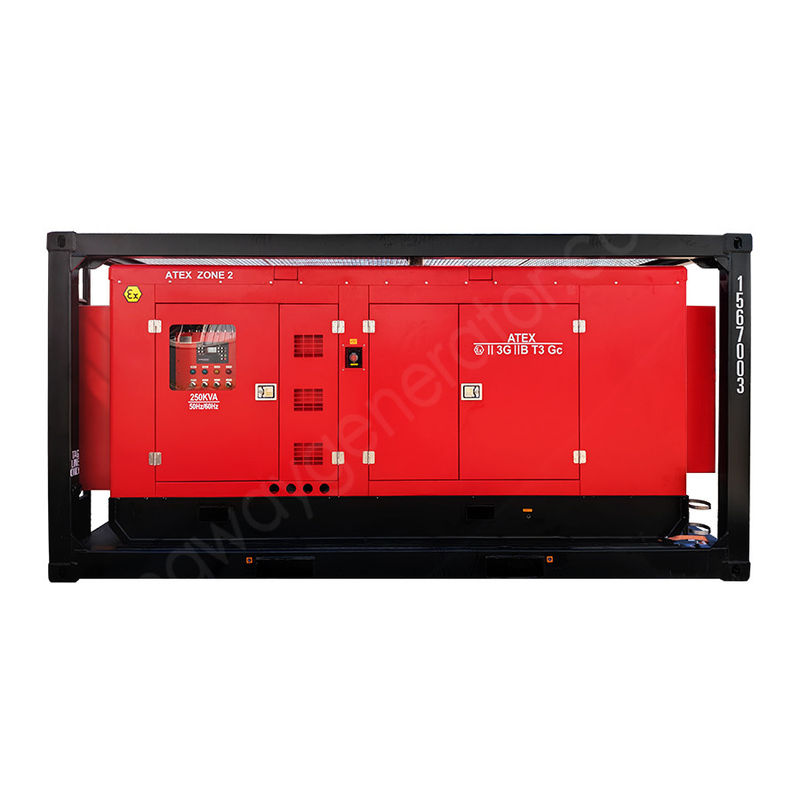
Compliance ATEX Zone 2 Generator Hazardous Areas Offshore Ready
Product Details
In the global industrial sector, safety is always the top priority, especially in environments with explosion risks. ATEX Zone 2 generator sets are special power equipment designed specifically for areas where explosive gas atmospheres are not likely to occur, and if they do occur, they only persist for a very short period of time.
Below is a detailed introduction to ATEX Zone 2 generator sets, covering their definition, core protection technologies and application scenarios.
Before delving into generator sets, it is necessary to first clarify the definition of Zone 2. In accordance with the European ATEX 137 Directive, hazardous areas are classified into different levels based on the frequency of occurrence of explosive atmospheres:
Zone 0 / Zone 1: Explosive gas atmospheres are present continuously, frequently or for long-term durations.
Zone 2: Under normal operating conditions, explosive gas mixtures are unlikely to occur; even if they appear, they only exist for a short time (typically less than 10 hours per year).
Though the risk level is relatively low, once gas leakage occurs, sparks or high temperatures generated by standard generator sets are sufficient to trigger catastrophic accidents. Therefore, Zone 2 generator sets must undergo special explosion-proof modification.
Product Parameters
| Equipment: | 5-2500KVA Explosion-proof Diesel Engine Genset | |||||
| Directive: | 2014/34/UE-ATEX | |||||
| Standard | EN 60079 series / EN 1834 series / EN 1755 | |||||
| Convert to: | Group II Equipment, Category 3G (Zone 2 II B T3 Gc ) | |||||
Applications
The biggest difference between Explosion-proof Generator Sets and standard generator sets lies in their specially designed surface temperature control and spark suppression treatments, which are engineered to cope with flammable and explosive gases, vapors or dust in the operating environment.
The main application scenarios of explosion-proof generator sets are classified by industry as follows:
1. Oil & Gas Exploration
This is the core application field for explosion-proof generator sets. In such areas, hydrocarbon gases exist constantly or intermittently in the air.
Offshore Platforms: With confined space and extremely harsh working conditions, generator sets are required to feature high salt-fog protection and hazardous area explosion-proof performance, supplying emergency or main power for living quarters and drilling equipment.
Onshore Well Sites: During exploitation and well testing operations, explosion-proof units prevent motor sparks from igniting oil and gas leaked by blowouts and causing explosions.
Shale Gas Fracturing Operations: Explosion-proof power distribution and power supply support are generally required around large-scale fracturing vehicle fleets.
2. Petrochemical Processing, Storage & Transportation
Refineries: Generator sets serve as standby power supplies near production and refining lines, ensuring the units will not become an ignition source even if minor gas leakage occurs.
Oil Depots & LPG Stations: In oil and gas loading, unloading and pumping areas, explosion-proof generators provide power supply for fire pumps and central control systems.
Chemical Warehouses: Warehouses storing volatile hazardous chemicals impose strict explosion-proof grade requirements on ventilation and emergency power supply equipment.
3. Pharmaceutical & Fine Chemical Industry
Many pharmaceutical processes involve organic solvents such as ethanol, which are highly volatile and prone to forming explosive gas mixtures.
API Synthesis Workshops: There is a risk of solvent volatilization during production, making explosion-proof power systems mandatory.
Powder Processing Zones: Certain pharmaceutical dusts are explosive, so the generator sets must be equipped with Dust Ignition Protection.
4. Energy, Mining & Tunneling Engineering
Underground Coal Mines: Gas (methane) is the major safety hazard in coal mines. Generator sets used underground must comply with mining explosion-proof standards (such as China’s MA certification).
Large-scale Tunnel Boring: When passing through geological layers containing natural gas, tunnel boring machines and their supporting power supplies must undergo explosion-proof modification.
5. Marine & Port Industry
Hazardous Chemical Terminals: During the loading and unloading of dangerous goods, on-site emergency generators must have explosion-proof capability to avoid chain accidents caused by cargo leakage.
Chemical Tankers & Oil Tankers: Used as on-board emergency or auxiliary generator sets, they must meet the explosion-proof specifications of classification societies (e.g., CCS, DNV).
Key Technical Features of Explosion-proof Generator Sets
To adapt to the above application scenarios, the units are normally integrated with the following technologies:
Explosion-proof Alternator: Adopts Ex d (Flameproof) or Ex e (Increased Safety) construction.
Air Intake & Exhaust System: Equipped with flame arrestors and water-cooled exhaust manifolds to strictly limit exhaust temperature (usually compliant with T3 or T4 temperature classification).
Automatic Protection Devices: Built with functions of automatic air intake cut-off against over-temperature and over-speed to prevent engine runaway.
Static Elimination: All external components must be reliably grounded to prevent static electricity accumulation.
![]()
![]()
![]()
Contact Person: Mr. Bruce Jia
Tel: +8618653247836
Fax: 86-532-55718566